
See the future —
without a crystal ball
Identify and predict a person’s mental workload, mental readiness, fatigue, and attention with eye-tracking. Works in any environment, on any device.
HOW IT WORKS
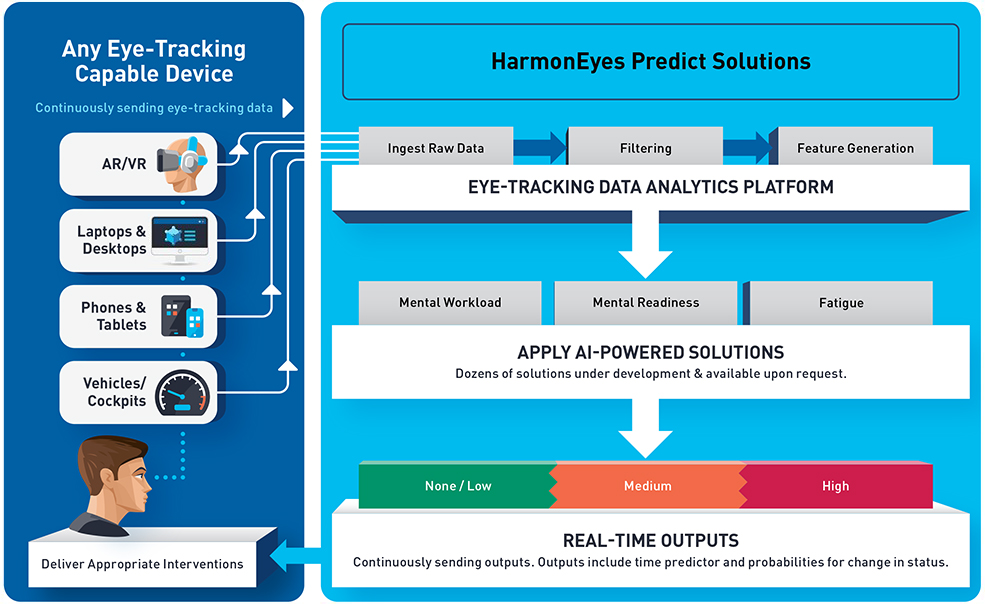
Predict what’s next with AI-powered insights
Over 90% of the brain is involved in vision-related tasks. Both completely objective and highly sensitive, eye movements provide unparalleled insights into a person’s current state — and now, with HarmonEyes, they also predict a person’s future state.
MODELS
See current Predict solutions — and what’s in the pipeline
HarmonEyes offers predictive eye-tracking solutions for multiple use cases. Check out what we’ve already developed — and what’s coming soon.
Attention
Interest
Fatigue
Gaze Control
Distraction (in development)
Emotion
Stress
Happiness (in development)
Positive/neutral/negative states (in development)
Cognition
Mental Workload
Expertise — visual search, discrimination (in development)
Decision making (speed, accuracy)
Learning
Real-time reading comprehension (in development)
USE CASES
Explore Predict use cases
Check out these use cases based on real-time changes in a user’s physiology, attention, and perception.

Gaming
Explore and access new possibilities for interaction, immersion, and personalization for gaming experiences.
- Scale your game dynamically based on your players’ cognitive load and fatigue levels. Keep people engaged longer and boost game favorability by prioritizing players’ comfort, endurance, and performance.
- Create more immersive and interactive gaming environments with dynamic visual effects triggered by gaze fixation.

Training
- Personalize the training experience by understanding user attention and needs and adapting training flows accordingly — liking pausing or reviewing when trainees are overloaded or fatigued.
- Identify performance strengths and weaknesses and augment simulations to improve skill acquisition and decision making.
- Improve targeting, focus, situational awareness, decision making, and outcomes using real-time feedback based on users’ gaze fixation. Understand where trainees are looking versus where they should be looking with visual search confirmation.

Driver & Pilot Monitoring
- Gain real-time insights on pilot/driver fatigue, cognitive load, and visual attention. Take immediate corrective actions — helping you make smart decisions and protect your people.
- Improve training effectiveness through objective performance assessments using eye movements.
- Ensure drivers/pilots look at the right place at the right time with visual search confirmation — enhancing flight safety and operational efficiency.

Reading & Learning
- Respond to reading patterns in real-time and deliver corrective actions — improving processing, comprehension, and learning.
- Optimize training processes in enterprise organizations like law firms by understanding whether or not what’s being read is truly understood.
- Monitor students’ reading skills over time with tried-and-true reading assessments, enabling tailored individual learning experiences. Identify if a learner needs a reading specialist (or another kind of specialist, like vision) and improve test scores.
- Measure student interaction and engagement during lectures or lessons and customize learning materials.

Industrial Metaverse
- Proactively identify and mitigate fatigue risks before they impact employee performance or safety — i.e. alert workers to take rest breaks or rotate shifts when levels are high.
- Optimize employee training scenarios to maintain high levels of engagement and operational readiness. Simplify tasks or review complex material when employees are overloaded.
- Stop motion sickness before it affects your users, allowing for all to benefit from XR environments.
- Improve industrial product prototyping by assessing how users interact with virtual prototypes.

Market Research and Advertising
- Leverage existing eye-tracking AI/ML models and eliminate the need to conduct expensive and time-consuming data collection and model development.
- Determine how people react to advertising, apps, and websites and improve outcomes by conducting consumer behavior studies based on eye movements.
- Gain deeper insights into human perception and interaction with behavioral and cognitive studies.

Defense
- Prevent soldiers from motion sickness, track their cognitive load and fatigue levels, and improve target effectiveness and overall team performance with eye movement-driven insights.
- Improve pilot and soldier simulations with predictive insights.
- Bolster solutions modeling and plan more effectively with cognitive load and fatigue awareness.

Contextual AI
- Use eye-tracking models as inputs to LLMs to create adaptive, human-centered experiences tailored to environment, focus, and more.
- Detect cognitive overload via eye-tracking and provide simpler explanations or extra examples.
- Identify reading difficulties (like when a user re-reads a passage), adapt response speed and detail level, and offer follow-up questions.